
Envisioned as a bridge between China and France, this new 278 m2 (3,000 sq ft) store offers the Maison’s Chinese clientele a setting that – true to Boucheron’s DNA – marries heritage and innovation to spark emotions. Nature is omnipresent here, just as in Ginza and Place Vendôme, a constant backdrop for visitors as they browse the store. Here, it creates a dialogue between French and Chinese references - a common language at the crossroads of both cultures.
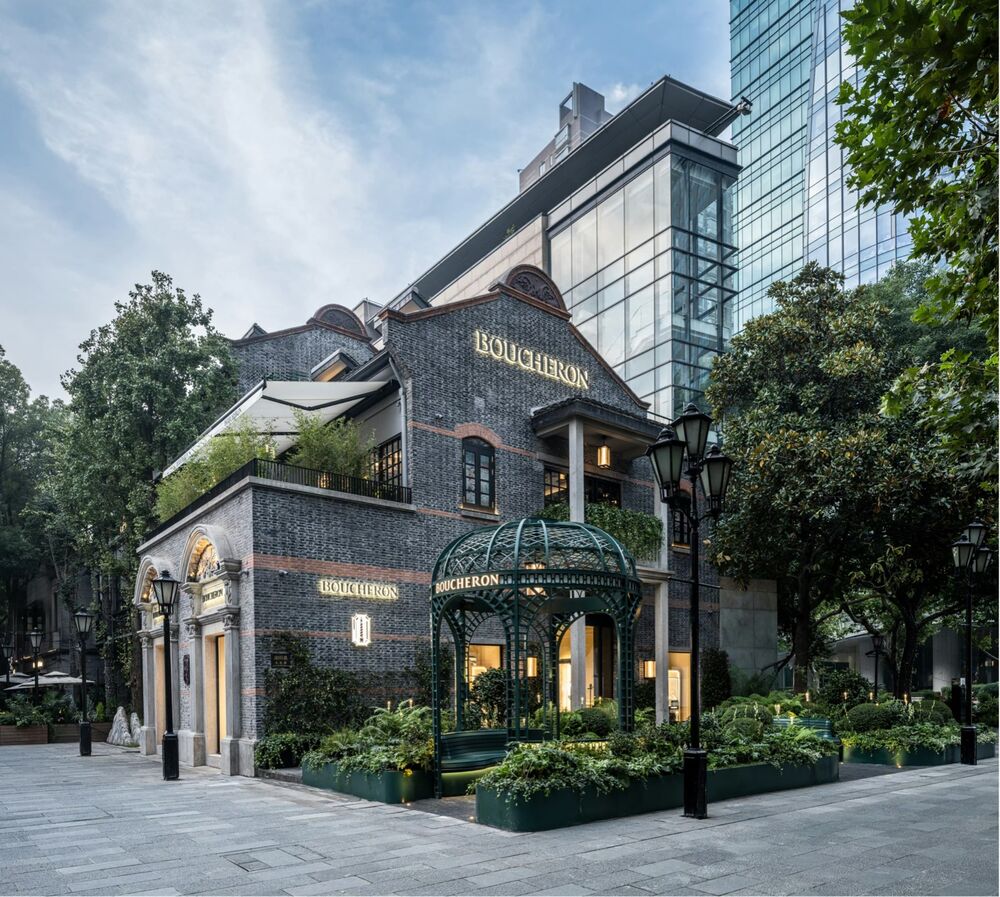
The Shanghai store drew on the same blueprint as Place Vendôme: the idea of taking over a building laden with memory and historical significance, to reveal its very soul. Located in the heart of the historic Xintiandi district, it’s housed in a distinctive 19th-century shikumen building.
Naturally, this heritage had to be preserved and celebrated. The Maison chose to retain the building’s architectural integrity while incorporating its own Art Deco codes of symmetry, metallic accents and the emerald cut.

Boucheron wanted to create a verdant oasis in the heart of the city. Echoing this natural theme, the store’s secondary entrance pays tribute to the poetic beauty of classical Chinese gardens.
A first landscape showcases nature in its lush, vibrant, untamed state so dear to Frédéric Boucheron’s heart – a reinterpretation of the winter garden that’s central to the historic 26 Place Vendôme store in Paris. In Xintiandi, a gazebo has been placed at the entrance; a visual beacon and a space to pause, it offers clients a sensory, reflective moment. Echoing this natural theme, the store’s secondary entrance pays tribute to the poetic beauty of classical Chinese gardens. Here, a Moon Gate typical of traditional architecture symbolizes the transition from one world to another.
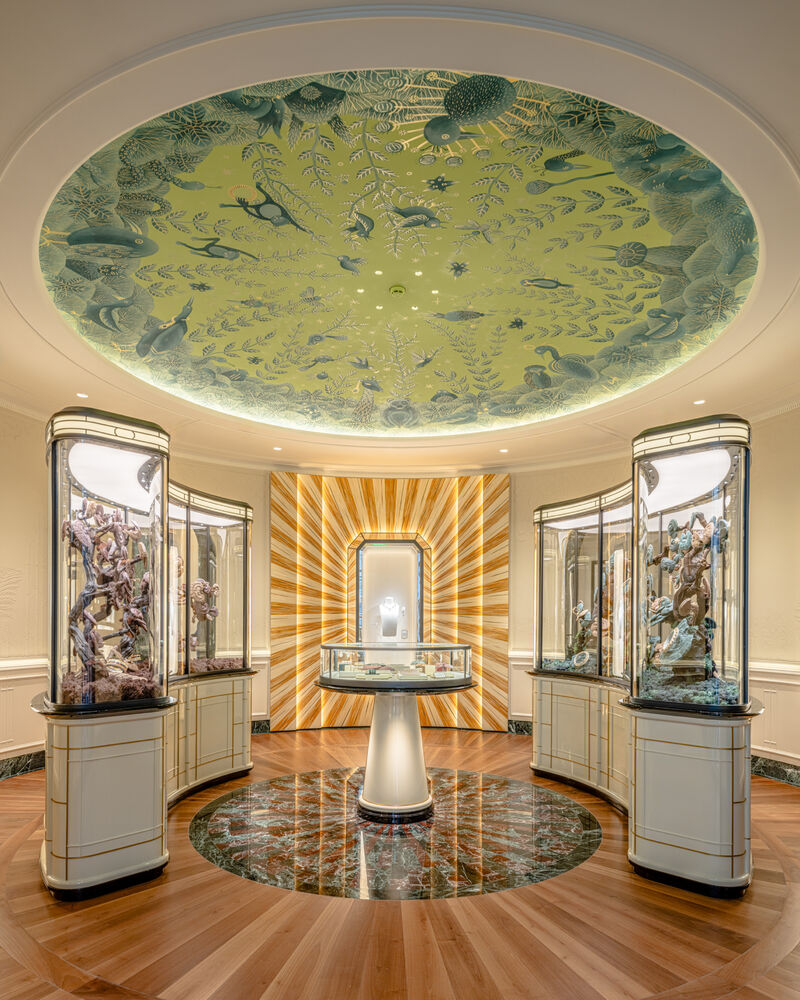
At the end of the outdoor tour, the shop awaits visitors. After these outdoor spaces, visitors enter the store itself via a first room that follows Feng Shui principles to favor a harmonious flow of energy. This universe and the atmosphere of a Parisian townhouse are subtly conveyed through artful woodwork and marble detailing, with bookshelves and oval tables lending a warm, inviting atmosphere.
A Chinese forest by artist Xiaojing Yan is displayed in central cabinets, a landscape alive with lingzhi mushrooms that symbolize immortality, health, and vitality. They also encapsulate the notion of nature being humble – like the undergrowth of a forest floor – which echoes Boucheron’s vision. Somewhere within it, this natural tableau conceals the Maison’s two icons, Serpent Bohème and Quatre. This same room displays two works by Huihui, a textile artist whose fiber installations engage with contemporary issues like sustainability, nature, pollution, ecological responsibility and globalization. Her socially conscious work is infused with a subtle, sensorial richness.
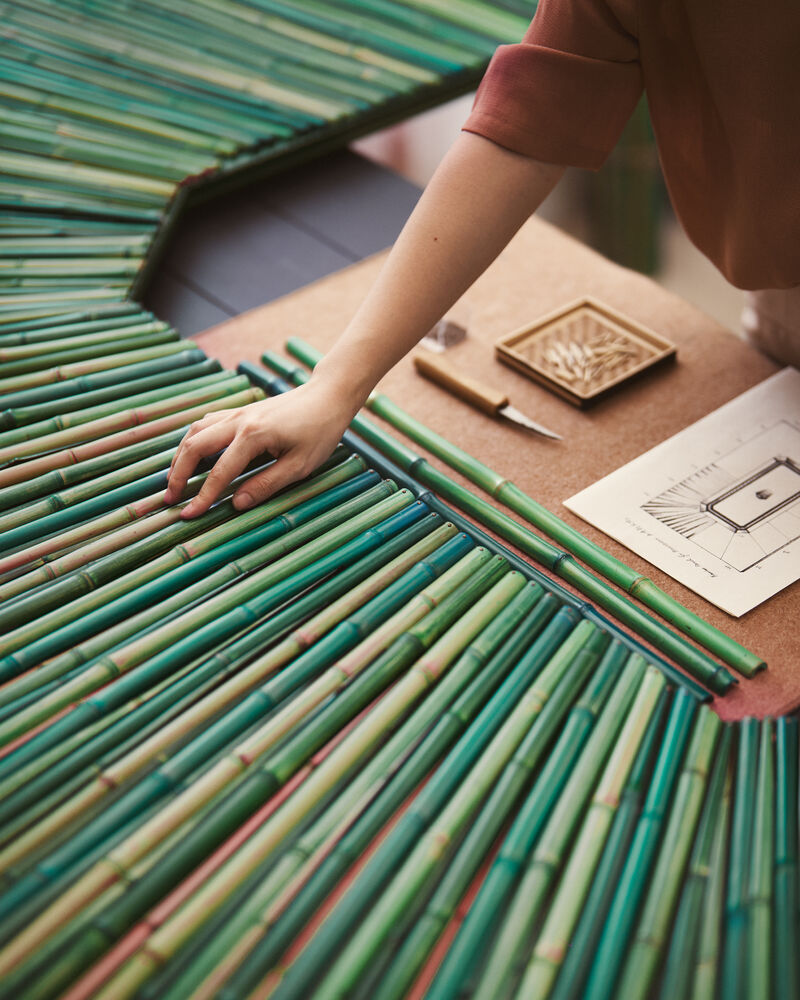
Artist Inkgo Lam Ka Yun has designed a sculptural display case with vibrant gradients of green, fashioned entirely in bamboo. The innovative treatment on this piece echoes from a distance the straw marquetry in the main entrance.
A dome painted on the ceiling by Claire Nicolet continues this narrative. The artist’s contemplative connection to landscape and her precise hand gave rise to a sky inhabited by an unfettered realm of imagined plants, flourishing amid natural motifs and a host of animals.
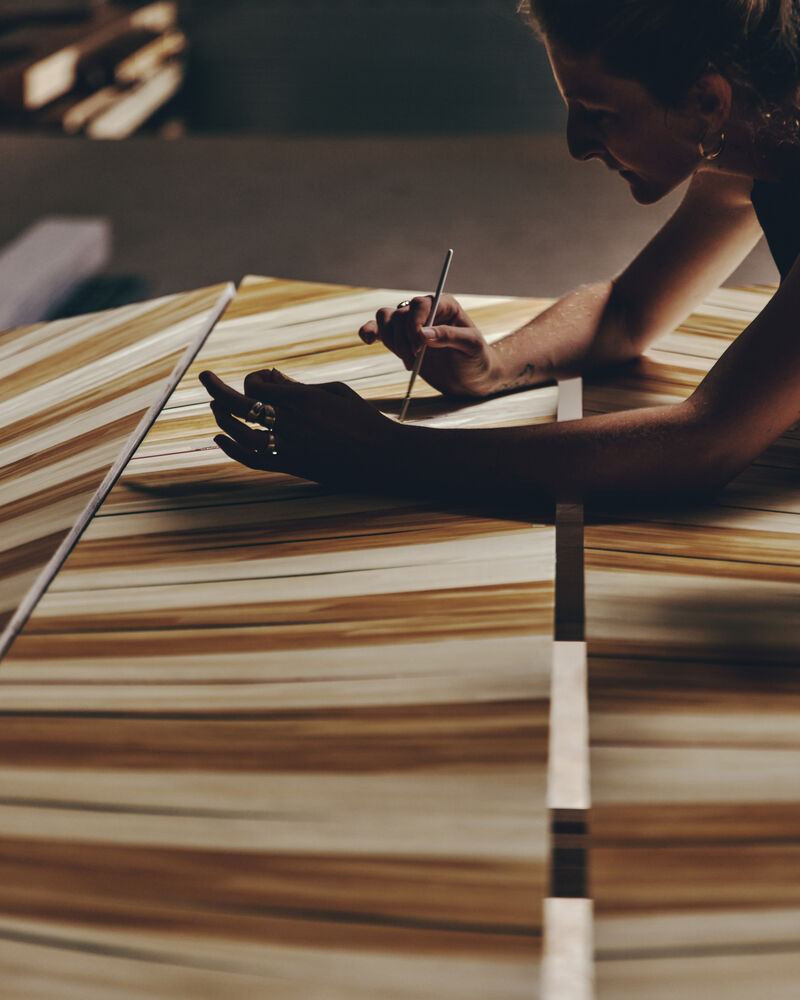
The central luminous showcase was created using straw-inlaid by artist Olga Thune-Larsen. Touches of red glass set into the marquetry pay homage to Asian cultures, where this color carries profound meaning, while green represents Boucheron’s emblematic color.
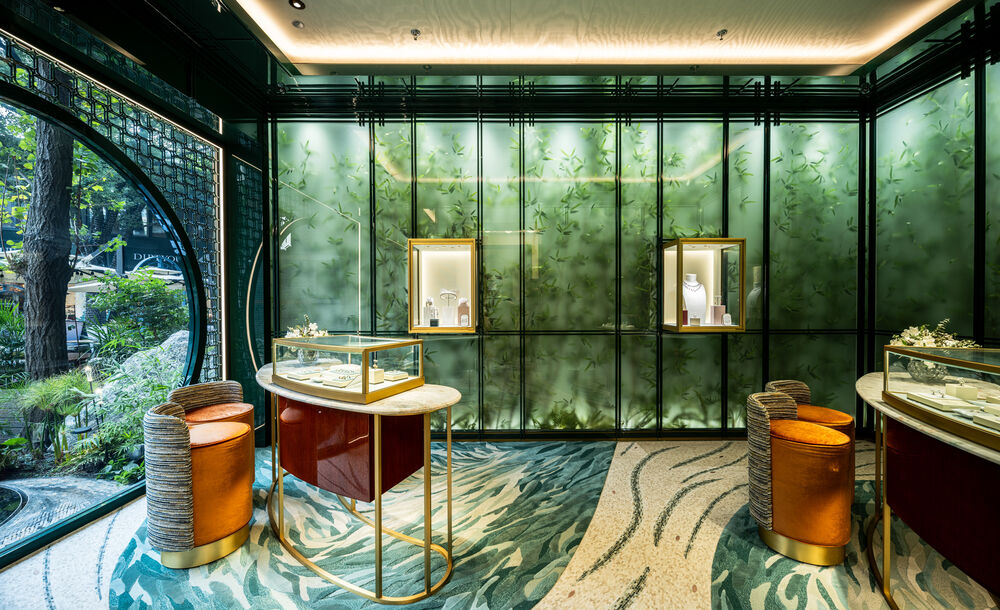
The bridal room is a total immersion in the spirit of Asia, inspired by the Yu Garden, Shanghai’s famous beauty spot with its many ponds A floor mosaic by Pierre Mesguich draws visitors into an underwater realm. Both the sand of riverbanks and the water of pools are represented in the design, infused with a dynamic energy from flowing currents and vegetation. To extend the metaphor, a carpet by Tai Ping conjures up the glinting reflections of light on rippling streams of algae. Symbolically the visitor stands surrounded by water, gazing towards the Moon Gate that frames a poetic view of the Chinese garden outside.
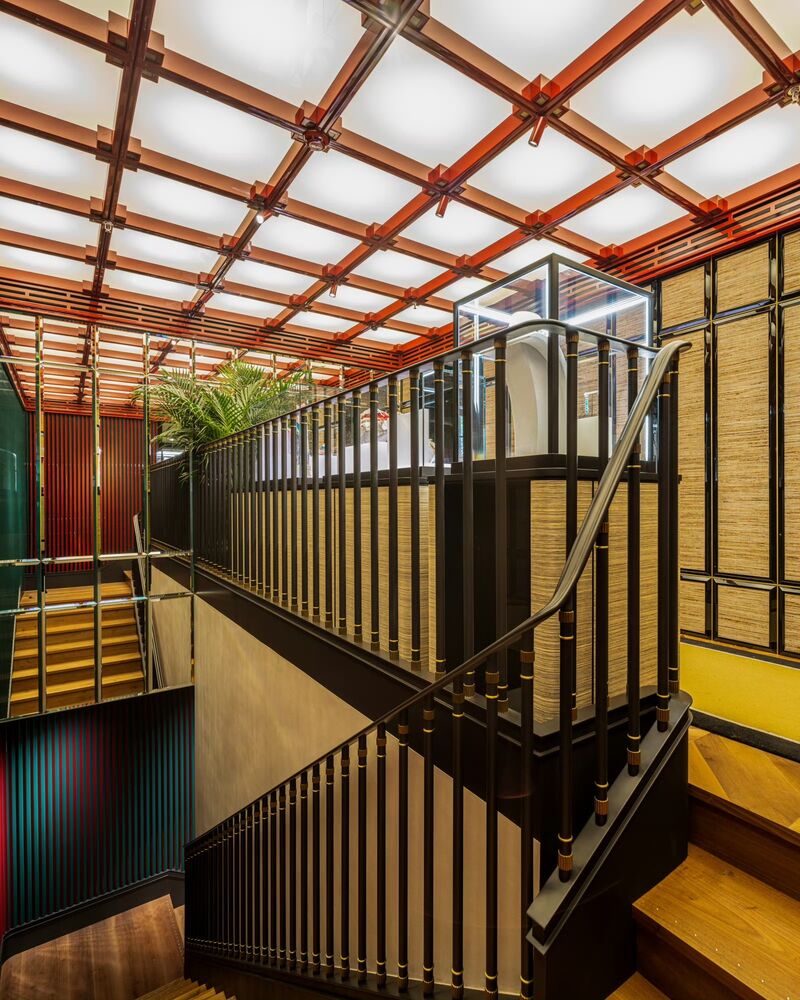
The fusion of Boucheron’s world with Chinese culture finds its fullest expression in the staircase leading up to the VIP lounge. On the wall, faceted metallic prisms reveal a playful twist – the Maison’s iconic emerald green on one side, and China’s emblematic red on the other. These hues shift as the perspective changes with each ascending step; the palette evolves, weaving a thread between the two cultures. . A bannister with Art Deco detailing draws the visitor upwards, while the raffia-clad Boucheron furnishings echo the spirit of the VIP lounge doors. This entire space is bathed in soft light from a coffered ceiling inspired by traditional Chinese architecture.
Eight works by artist Jonathan Bréchignac greet visitors at the top of the stairs. His Alien Rocks series draws from geology, history, and ancient mythology to create imagined stones that blend raw materials with hybrid elements.
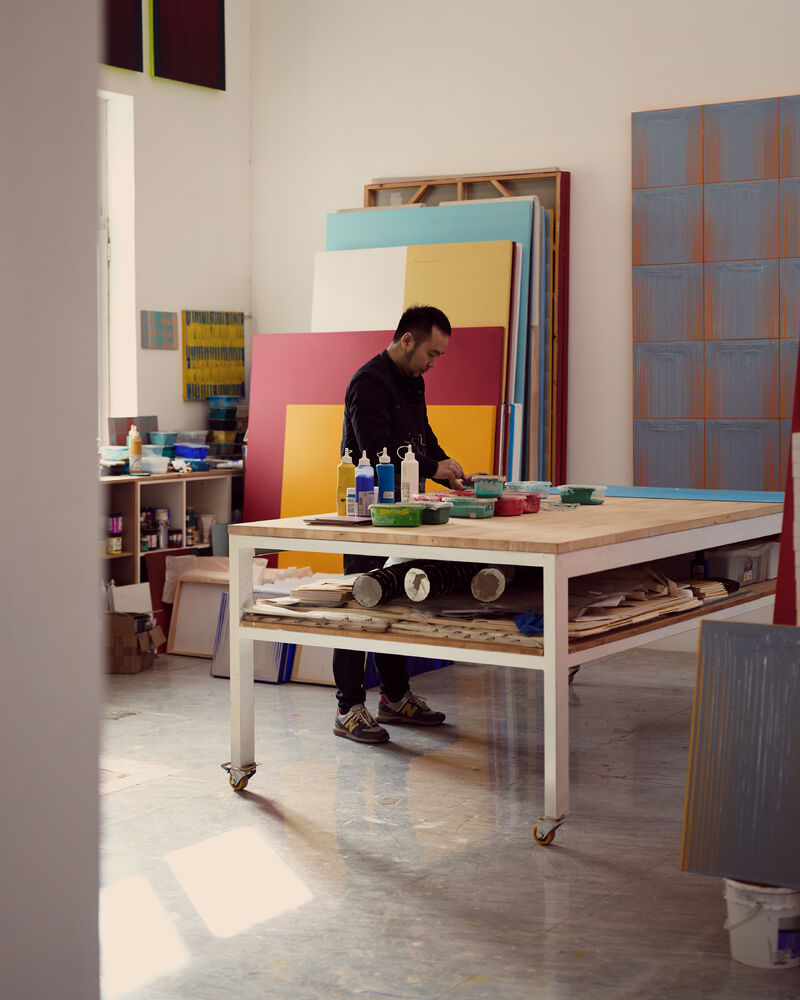
In one of the VIP lounges, the Maison chose to exhibit the work of painter Peng Yong. In his representations of China’s huge megacities, Yong uses repeated brushstrokes to depict an aerial view of their endless, orderly grid of identical streets. The Maison is displaying two pieces from his 3000 Realms in a Single Moment of Life series.
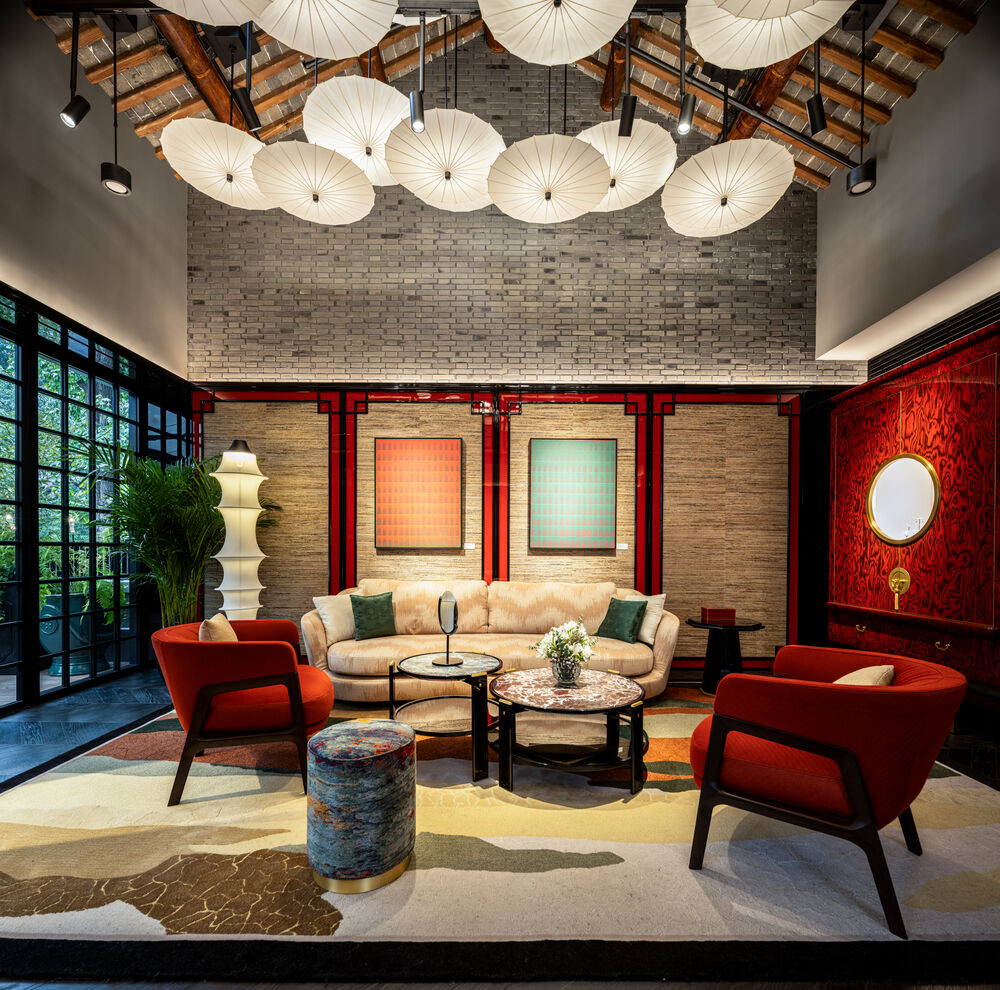
Like the reception rooms of a genuine home, two welcoming VIP salons receive visitors in a cozy, familial atmosphere. All the soul of the shikumen house can be felt here, in the exposed beams, original brickwork and original features that preserve the building’s authentic character. These spaces are designed to offer a warm and attentive welcome, with every detail carefully considered to reflect Boucheron’s family spirit. A raffia sofa with Asian-inspired patterning echoes the raised, mountainous texture of the carpets, while the colors of the wooden latticework, Chinese cabinets, armchairs, and marble tabletops alternate between green and red in a seamless blend of the two cultures’ aesthetics. The walls are decorated with De Gournay wallpaper depicting a dreamlike Asian landscape against a gold leaf background. Its design draws directly on Wang Ximeng’s masterpiece One Thousand Li of Rivers and Mountains, which is exhibited at Beijing’s Palace Museum.
Xintiandi Unit 01, No. 18, Lane 181, Taicang Road, Huangpu District, Shanghai
Change country/region