Boucheron: In Focus A Monograph of a Visionary in collaboration with Christie's New York from October 9 to October 18, 2026. Book your visit.

In this new Carte Blanche collection, “Impermanence”, Claire Choisne seeks to capture the very essence of nature. The collection invites a deeper contemplation of our natural world, so as to better protect it.
Inspired by Japan’s art of flower arranging, ikebana, and its philosophy of wabi-sabi, Boucheron’s Creative Director has dreamed up six botanical compositions, each frozen in its evanescent beauty. From the lightest to the darkest, together they embody how nature is gradually vanishing. Light is the common thread running through this collection; initially omnipresent, it fades by degrees, dwindling away into a pitch blackness that suggests the end of a natural cycle. These compositions are made up of 28 pieces of true High Jewelry to wear on the body.

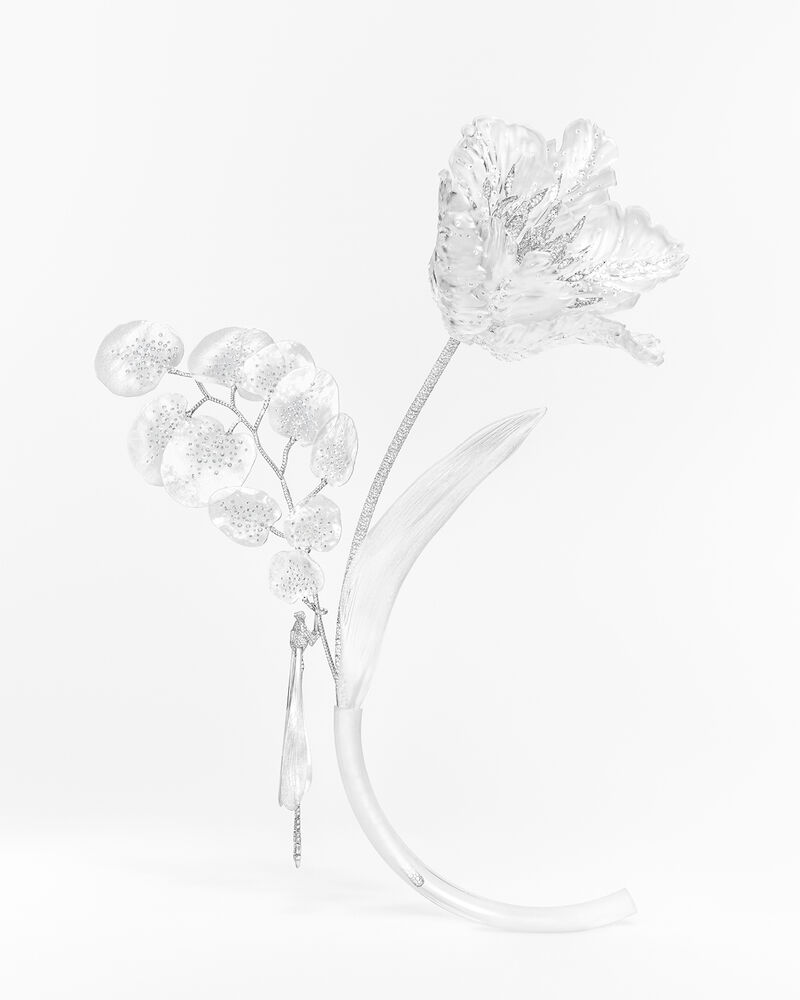
To convey the delicate beauty of these two pavé diamond-set plants, the Creative Studio elected to work in borosilicate glass. Boucheron’s artisans fashioned the glass by hand, after mastering the glassmaking skills to draw it out to an extreme fineness of just 2 millimeters. A dragonfly of white gold and diamonds has come to rest in this composition. Its wings were formed by overlaying sapphire glass onto a film of mother-of-pearl that mimics their natural iridescence. The vase that holds this ecosystem was also hand-fashioned from borosilicate glass.
When picked, the eucalyptus becomes a brooch or a piece of hair jewelry; the tulip transforms into a brooch, while the dragonfly is suspended from an ear.
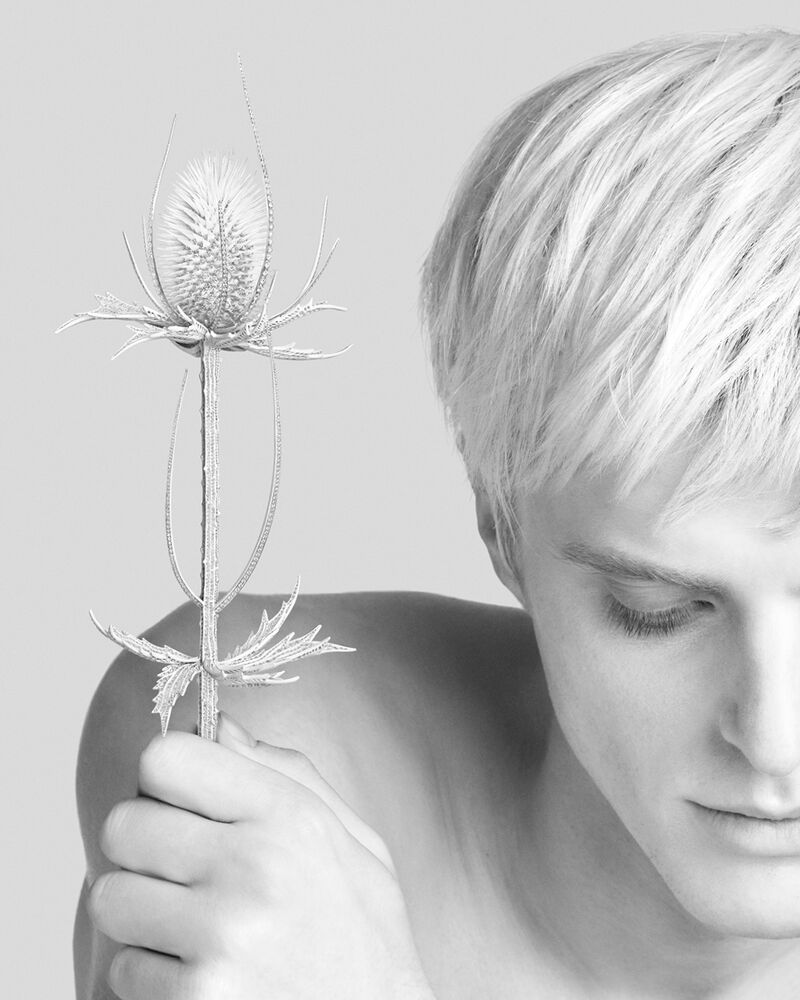
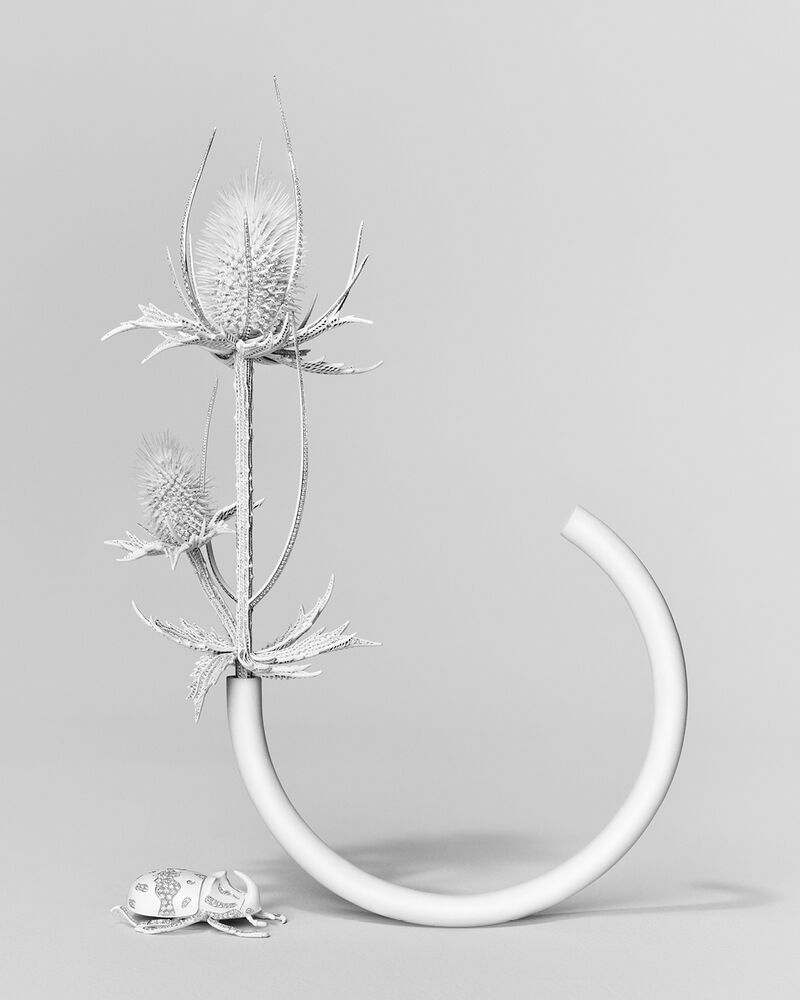
To convey the wild beauty of the thistle, its spiky flower heads were 3D-printed using plant-based resin, a material that hadn’t yet been used in High Jewelry. But this innovation presented the artisans with a real challenge: without any metal structure, it would be impossible to set a single diamond into the blooms. They had to devise a new setting technique, sewing more than 800 diamonds into the thistles’ alveoli by hand. The rhinoceros beetle and the plant’s stems, spikes and leaves were fashioned in white gold and set with diamonds, then coated in a fine layer of white ceramic. The thistle is housed in a vase made from an ivory-white composite material.
When picked, the larger thistle can be worn as a brooch or as a crossbody jewel; the smaller thistle detaches to become a double-finger ring, and the beetle becomes a brooch.
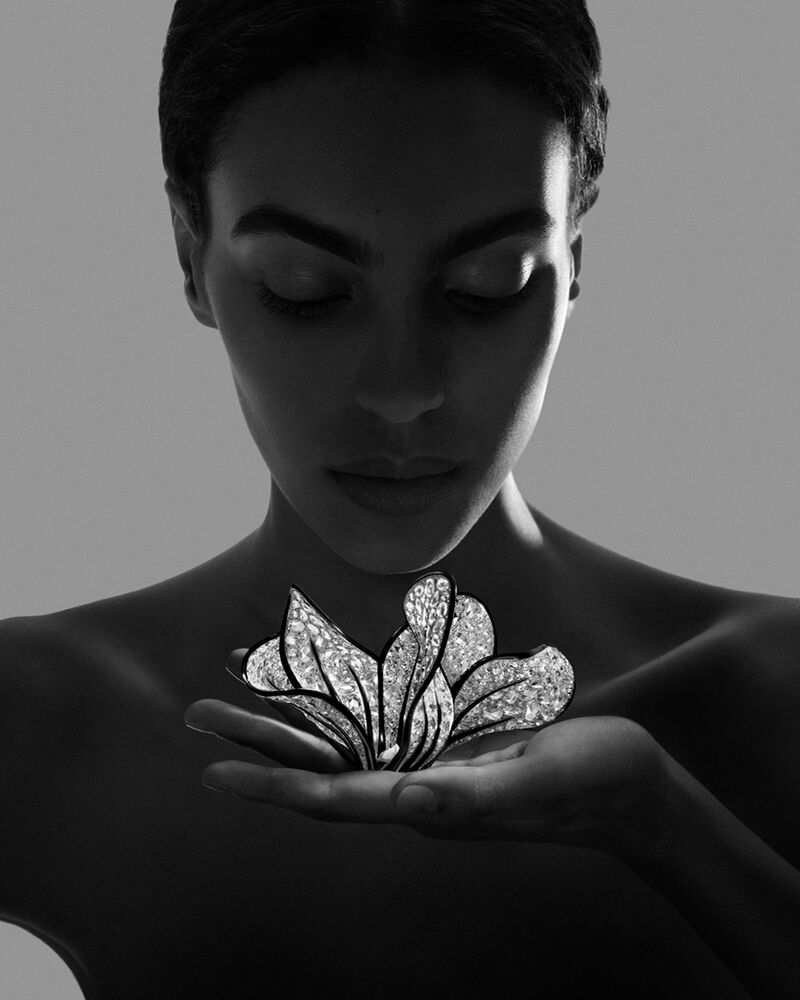
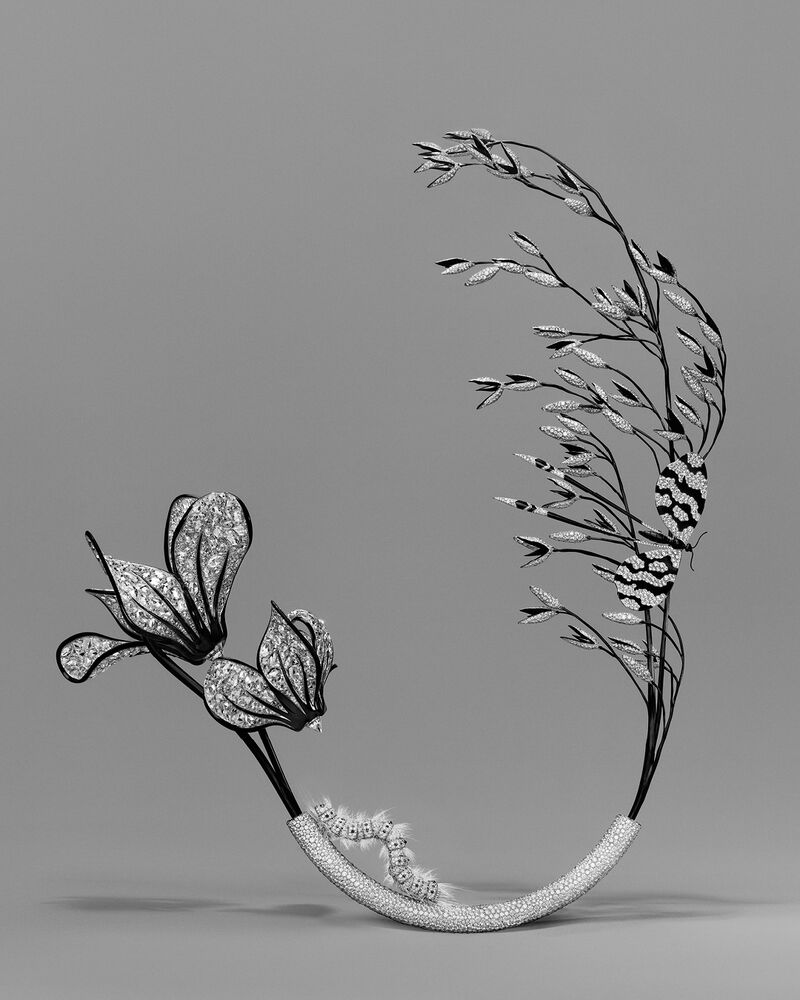
Here, the real tour de force lies in the setting of almost 700 rose-cut diamonds into the cyclamen’s white gold petals to form a virtual stained-glass window of diamonds. The oat stalk is made of black-coated titanium, minutely sculpted into spikelets that are also set with diamonds. Two insects inhabit this ecosystem. One is a caterpillar, crafted in white gold set with diamonds and softly rounded black spinels. Its fine hairs are mimicked by the fibers of a brush similar to those the Creative Studio employs, and an articulated body allows it to arch or flatten. The second, a butterfly, displays open wings of white gold, encrusted with diamonds and accented by black lacquer. The white gold vase is set entirely with diamonds.
The cyclamens have a pivoting mechanism that transforms them into a bracelet or brooch, the oat stalk turns into a hair jewel and the caterpillar is a brooch, while the butterfly sits in the hair.
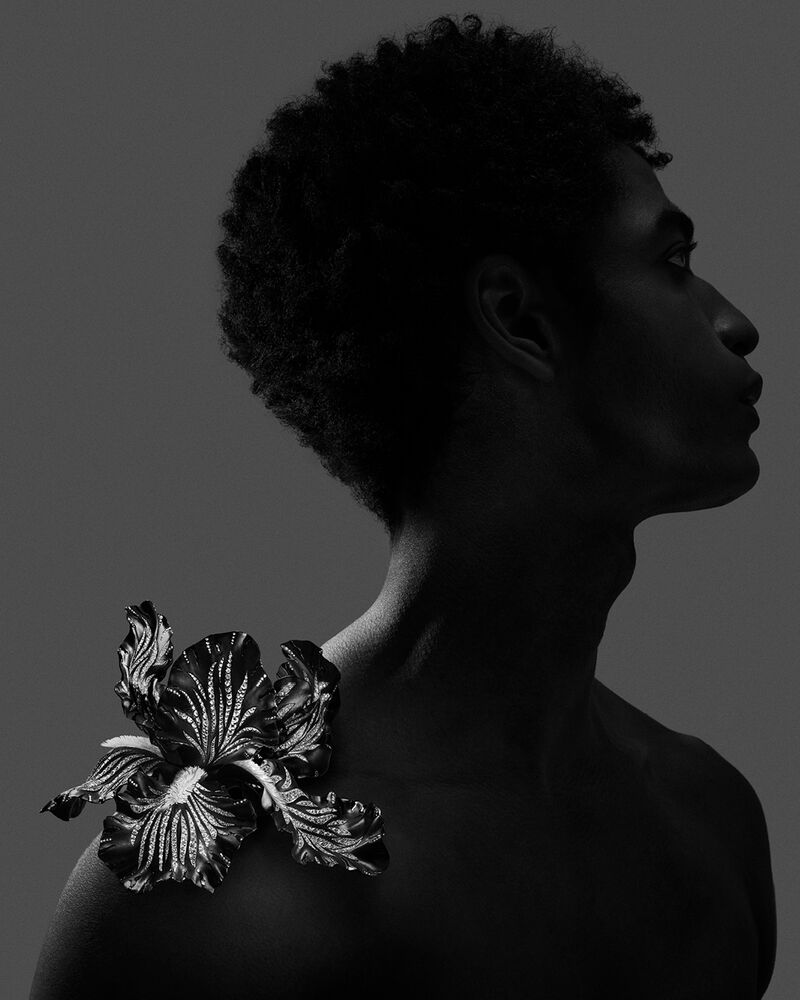

Boucheron’s artisans explored different shades of black on the iris, juxtaposing matte finishes across some of the petals’ expanse with glossy striped markings. Diamonds set into white gold pattern the flower’s surface and contours, with their tracery of white lines. The wisteria presented a twofold challenge: making it as weightless as possible, yet robust. The artisans solved this by combining ceramic, titanium and aluminum, keeping its total weight down to just 150 grams. White ceramic and a pavé setting of diamonds reintroduce light into the leaves and petals. A stag beetle nestles at the base of the composition. Its body sculpted in titanium with bands of white gold, has a shiny black finish that contrasts starkly with the pavé diamonds. The vase is made of aluminum and titanium, and set with black spinels.
The iris detaches to form a shoulder brooch, while the wisteria can be worn as a jewel in the hair or on clothing, and the stag beetle becomes a brooch.
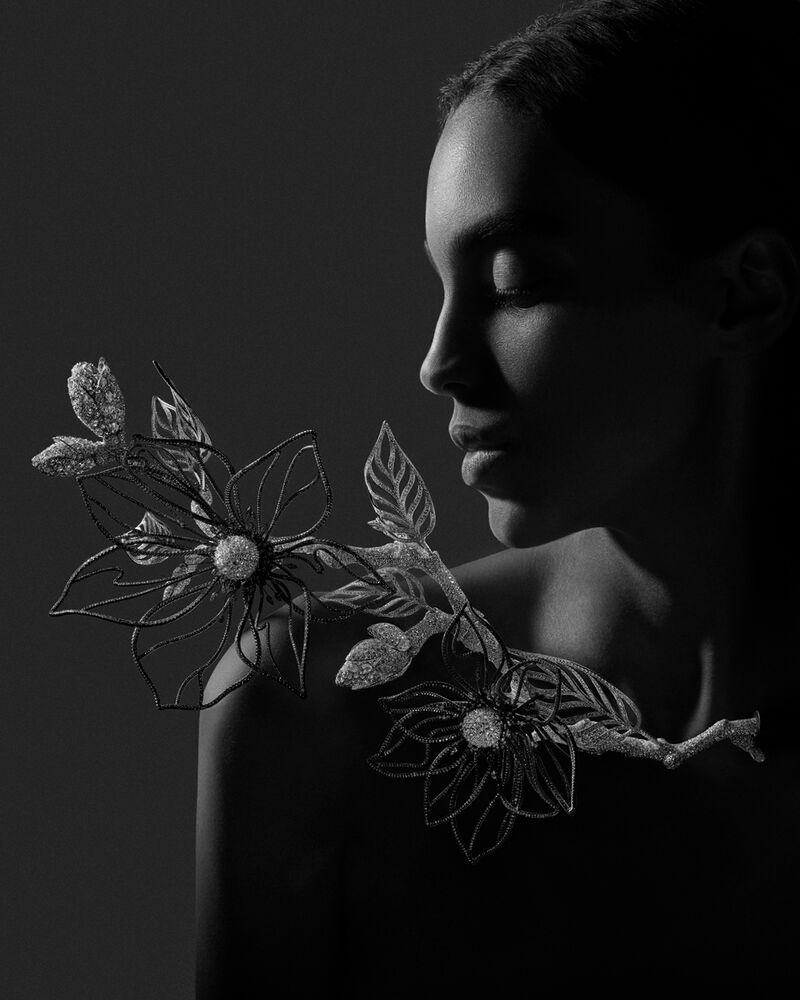
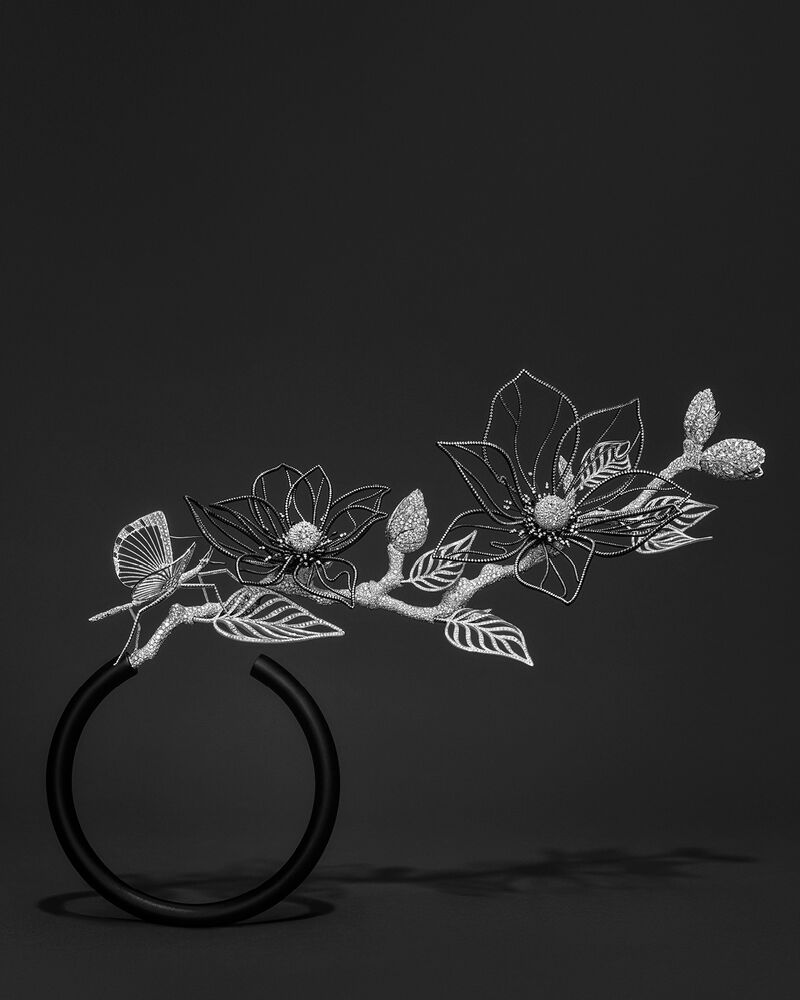
To achieve the lifelike realism they desired, the artisans scanned a real magnolia, including its branches, flowers and buds. The magnolia was crafted in aluminum to give a dazzling white finish and retain its naturally horizontal silhouette, offsetting any inherent imbalance. A linear pavé of flush-set diamonds makes the black ceramic-coated aluminum petals sparkle, while the blooms’ white gold heart is paved with diamonds in an inverse setting. A stick bug dwells in this realm of light and shadow. It is crafted from white gold, its body and wings embellished with diamonds. The arrangement rests on a vase of a matte black composite material.
The magnolia transforms into a head jewel or a collar necklace, while the stick bug detaches to form a brooch.
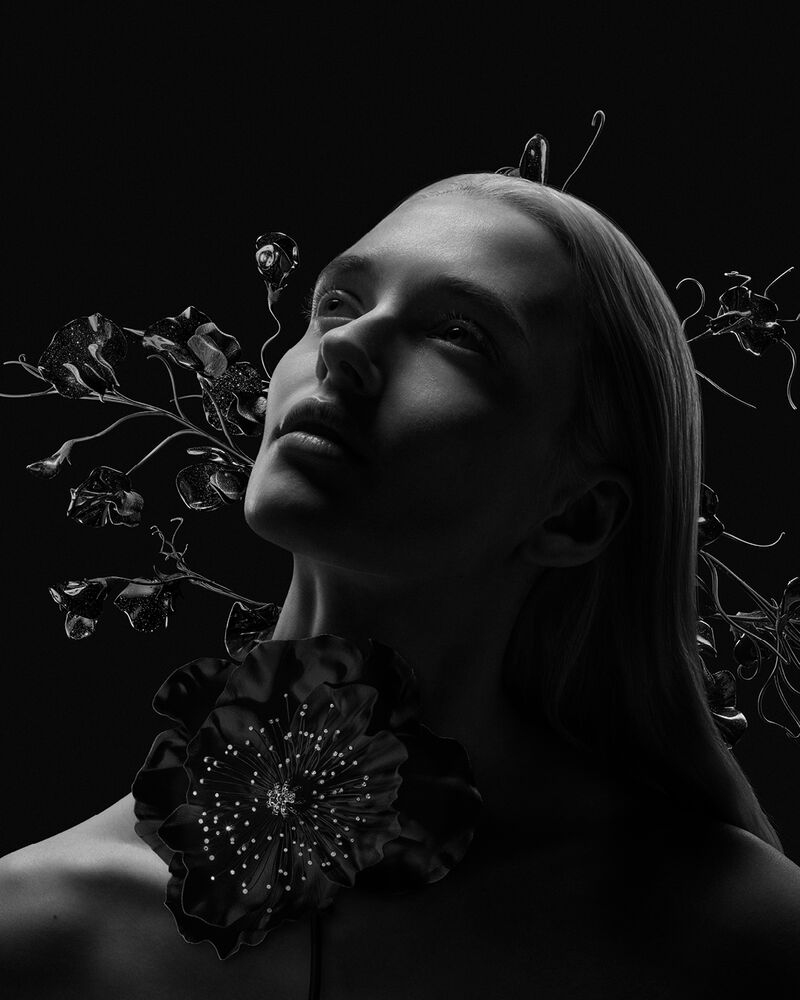
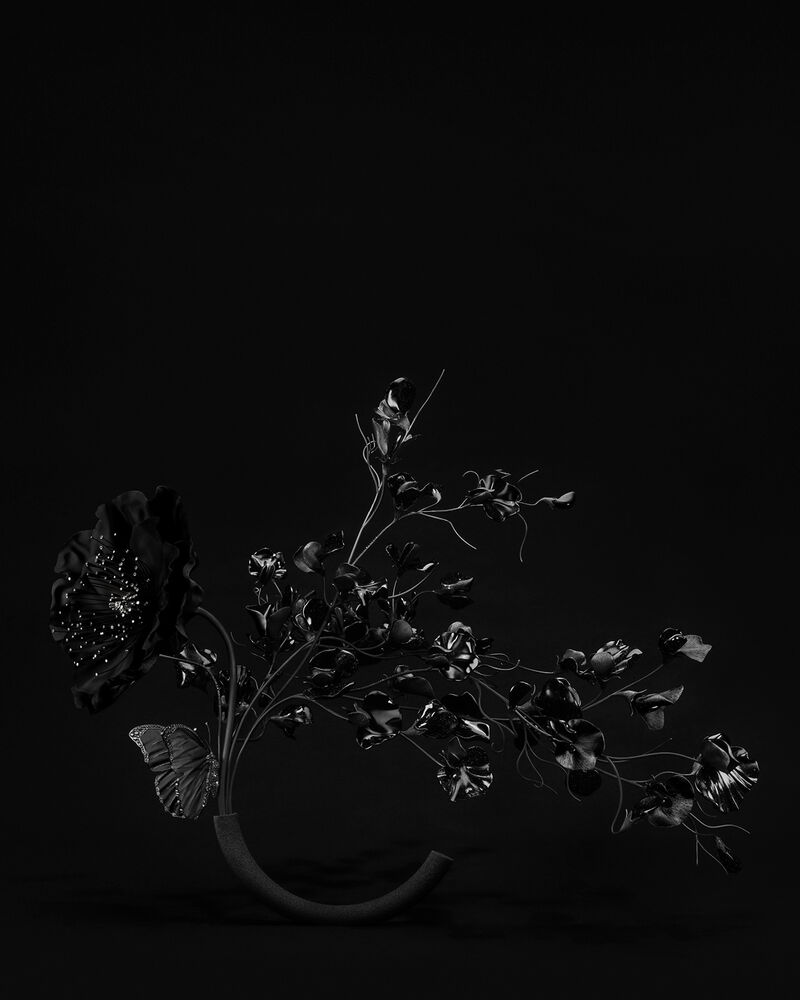
The poppy contains the most innovative element of this entire collection. Its matte black titanium petals have hand-etched veining on the inside with a coating of Vantablack® – one of the darkest materials ever created. The heart of the flower is set with black spinels, some face up, some upside down. As for the sweet pea, its coiling titanium tendrils are embellished with black spinels. The sweet pea’s flowers were painstakingly sculpted from onyx and black aventurine glass to give their petals an exquisite delicacy. A butterfly lingers in this near-total darkness. Its matte-black titanium body is set with black spinels, and it has wings of transparent black glass that was custom-developed to give a translucent effect. This arrangement rests on a vase made by 3D-printing black sand.
Once removed from the vase, the poppy turns into a headband or brooch, the sweet pea blossom transforms into different brooches, and the butterfly seems to take flight and come to rest on clothing, as a shoulder brooch, thanks to its system of magnetic fasteners.
In this new episode, meet Hélène Poulit-Duquesne, CEO of Maison Boucheron, and Claire Choisne, Creative Director, as they reveal—for the first time ever—what makes their extraordinary partnership so unique and powerful.
Change country/region
